

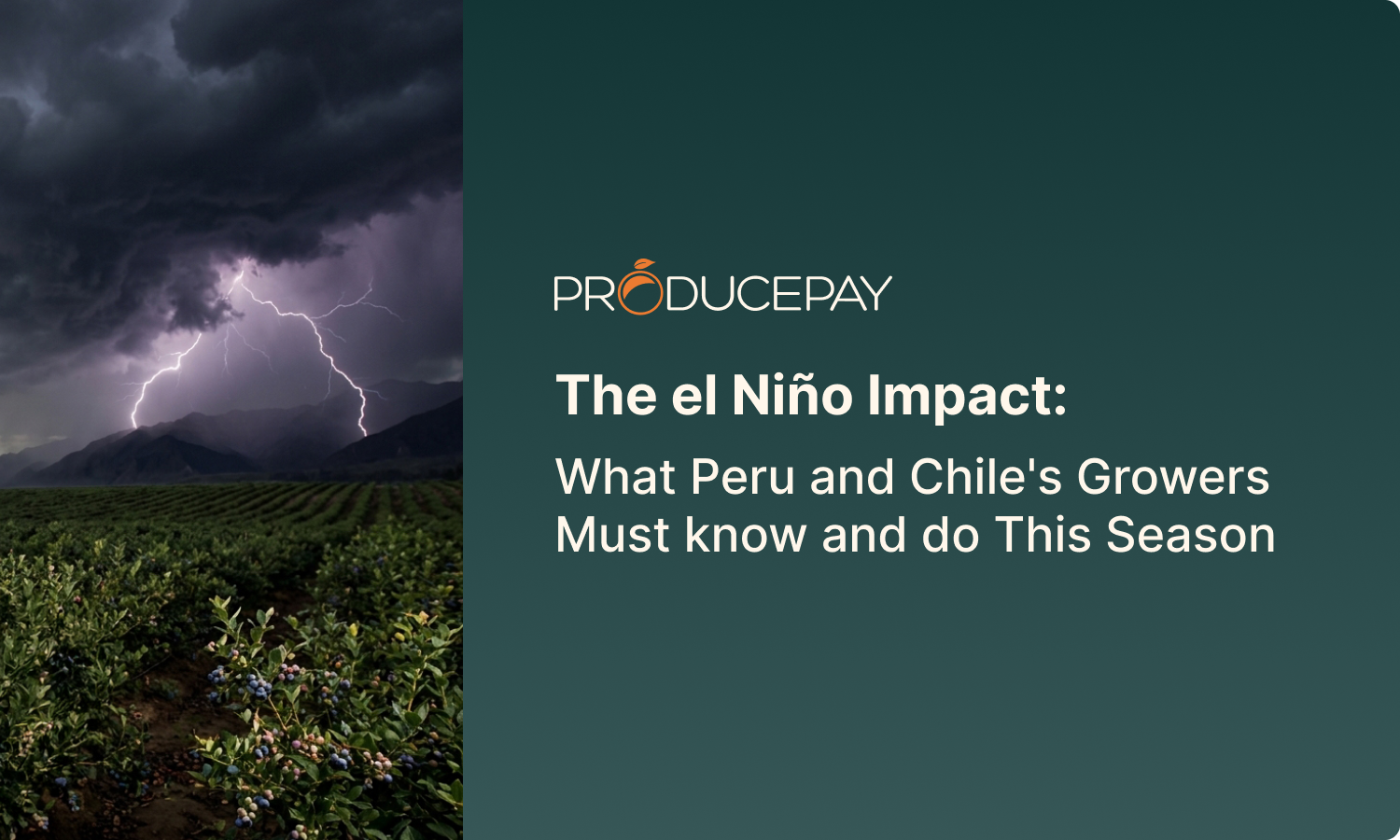
What El Niño Means for Peru and Chile This Season — And What Growers Are Doing About It
The Pacific is warming. NOAA has confirmed El Niño conditions are underway, with probabilities for a strong or super event running as high as 98% through the second half of 2026. For produce growers in Peru and Chile — whose harvest windows run directly through the August–December peak risk period — this isn’t a forecast to monitor from a distance. It’s a season they’re already managing.
The climate conditions affecting each country are different. Peru faces heat. Chile faces rain. But the underlying challenge is the same: an El Niño event that peaks exactly when the most valuable crops in South America are in their most vulnerable stages.
Here is what the data shows, what growers on the ground are seeing, and what it means for the season ahead.
98%
Probability
El Niño developing through H2 2026 (IRI/Columbia)
+2.1°C
Sea Surface Anomaly
Recorded off Peru’s coast (Niño 1+2 region)
41%
Blueberry Export Drop
Peru’s loss in the last major El Niño event

What’s happening on the ground
In Peru, heat is the defining risk. Sea surface temperatures off the northern coastal growing regions — Tumbes, Piura, Lambayeque — have already reached 28 to 29°C, well above normal. Some northern stations recorded 160mm of rainfall in just three hours earlier this year, exceeding entire monthly averages. And conditions are forecast to intensify from August through December — exactly when Peru’s blueberry and grape campaigns are at their most critical stages.
La Libertad accounts for approximately 50% of Peru’s fresh blueberry exports, with Lambayeque, Ica, and Piura making up most of the remainder — meaning the entire northern blueberry corridor is in the crosshairs. For weather exposure specifically, Piura and Lambayeque face the most severe flooding risk. Peru’s flood risk data shows Piura has over three times the agricultural land under very high flood threat compared to La Libertad, and SENAMHI’s regional director in Piura has warned the current event could be the strongest since 1951. The risk to blueberry volume is concentrated in La Libertad. The risk to infrastructure, roads, irrigation canals, and packing logistics runs deepest in Piura and Lambayeque.
The specific crop risks:
→ Blueberries: Warm winters reduce chilling-hour accumulation, disrupting flowering and bud break. The industry remembers 2023/24, when high temperatures caused certain varieties to abort flowering entirely in favor of vegetative growth. High humidity creates ideal conditions for botrytis, powdery mildew, thrips, and mites.
→ Grapes: Warm conditions are triggering earlier harvest starts, compressing the Piura and Ica windows and reducing berry sizing. Timing shifts can create gaps and surges in supply that are difficult for buyers to plan around.
→ Avocados: Poor tolerance of waterlogged soils creates root stress risk when fields remain saturated. The combination of warm nights and standing water accelerates disease pressure significantly.
How growers are adapting
Peru’s agricultural sector has lived with El Niño longer than almost any other in the world. As Juan Manuel Benites, former agriculture minister, noted: “We have a stronger El Niño culture in Peruvian agriculture; agribusinesses take precautions and know what to expect.” That institutional memory is proving valuable.
In the blueberry sector, varietal replacement has emerged as the most significant structural adaptation. In La Libertad, Lambayeque, and Ica, older plantations have been replaced with zero-chill and low-chilling-hour varieties that maintain productivity and fruit firmness under heat stress. Technical advisors report these new varieties are already showing stronger performance in the warmer conditions of this winter.
Preventive fungicide programs are being accelerated ahead of schedule. Drainage infrastructure is being reinforced. And the industry’s association Proarándanos has moved its annual congress earlier in the year to align strategy with the evolving forecast.

What’s happening on the ground
In Chile, the risk profile is almost the inverse of Peru’s. Where Peru faces heat and early harvest compression, Chile faces excess moisture — heavy spring rains, potential hail during bloom and fruit set, and the most feared scenario for the cherry industry: rain events near harvest in November and December that cause cracking.
The regions most exposed are O’Higgins, Maule, Ñuble, and Biobío — the heart of Chile’s cherry industry, and a zone where Chile’s Meteorological Directorate (DMC) projects above-normal rainfall accumulations for August through October, with accumulations potentially exceeding the 66th percentile of historical climatology. Recent events have pushed El Niño’s wettest impacts further south than historical patterns would suggest, extending the risk zone into areas that growers once considered relatively protected.
Researchers at CR2 (Universidad de Chile’s Climate and Resilience Science Center) note that models point to a real probability this event reaches ‘strong’ or ‘very strong’ category — comparable to the major events of 1983, 1987, 1997, and 2016. Of the seven prior years reaching this level of Pacific warming, all but one saw annual accumulated precipitation above 400mm in Chile’s central zone, including the wettest years on record. The exception — 2015’s El Niño — is a reminder that probability is not certainty. But as CR2 states: ‘the greater probabilities point to a rainy winter that people and institutions must be prepared for.’
Chile’s cherry crop is at record scale this season. That means even a modest percentage of rain-affected fruit translates into significant volume and condition variability at destination. The industry is not dealing with a narrow margin for error.
The specific crop risks:
→ Cherries (highest risk): Root health risk begins before flowering even starts. Heavy late-winter rain can waterlog orchard soil weeks before bloom, causing root asphyxia within hours as oxygen is depleted — weakening the tree’s capacity to support budbreak and florescence, and reducing uptake of critical micronutrients like boron and zinc. According to INIA Quilamapu, growers should clear drainage canals and reinforce drainage in low-lying orchard areas before the rains arrive, not after. Spring rains and hail from September–October raise botrytis and Phytophthora risk during bloom. Near harvest in November–December, rain causes cracking — but the fruit’s vulnerability to splitting is largely determined weeks earlier, during cell division after fruit set, when the cuticle thickness that resists water entry is established. Covered orchards remain the only reliable physical barrier against rain-driven cracking. With record volumes this season, even a small percentage of affected fruit has major commercial consequences.
→ Grapes and blueberries: Spring rains raise botrytis and downy mildew risk during flowering and early fruit development. Condition problems and reduced firmness carry into the shipping season, affecting value on arrival rather than volume at harvest.
→ Stone fruit — nectarines, peaches, plums: A warm, humid spring accelerates maturity and compresses harvest windows, creating logistical pressure and reducing flexibility in timing shipments to market.
How growers are adapting
Chilean growers have made meaningful structural investments in anticipation of increased climate volatility. Covered cherry orchards are expanding to protect bloom and developing fruit from rain events. Beyond infrastructure, growers are taking lower-cost preventive steps ahead of the season: clearing irrigation canals and drainage ditches, and reinforcing drainage in the lowest-lying orchard areas so water moves off the property quickly instead of pooling around roots. Preventive fungicide programs — particularly targeting botrytis and downy mildew — are being applied earlier and more intensively than in standard seasons, consistent with what growers did in the last comparable El Niño years.
The response extends beyond individual farms. Chile’s government activated a formal risk-monitoring protocol for vulnerable growing regions in July. The state crop-insurance program Agroseguros has made subsidized coverage available specifically for excess-rain damage this season. And Chile’s insurance and brokerage industry — through a joint session between Marsh and the National Agriculture Society — has been pushing growers and exporters to review their coverage and supply-chain contingency plans before the season begins. Frutas de Chile, the fresh fruit exporters’ trade association, has confirmed that authorities are actively monitoring conditions, citing “a much more erratic and intense climate than in previous years.” Both the public and private sectors are treating this as a supply-chain risk, not just a weather event.
Buyers are also being asked to plan for disruption. Summit Produce is monitoring weekly ENFEN, SENAMHI, and NOAA updates alongside growers on the ground in both Chile and Peru, adjusting arrival forecasts and allocation plans as the season develops.
How ProducePay financial solutions can help you weather the storm
El Niño seasons have a specific financial signature. Costs arrive early and increase — for preventive programs, infrastructure, additional labor. Yields become uncertain. Harvest windows compress. And the gap between when a grower needs capital and when their buyer’s payment arrives gets wider, not narrower, precisely when the margin for error is smallest.
This is the operating environment ProducePay was built for. We work with growers in both Peru and Chile across the full season arc:
→ Before the season: Pre-Season financing from planting through harvest, using future harvest as collateral. No physical assets required. For growers investing in covered infrastructure or accelerated preventive programs this season, capital that arrives before harvest is the difference between adapting and absorbing the loss.
→ When shipments move: Quick-Pay converts shipments already in transit into same-week liquidity. In a season where harvest windows compress and timing uncertainty is high, growers can’t afford to wait 75–90 days for payment on fruit that’s already sold.
→ All season long: Visibility into shipment data, GMV, and final pricing in real time — so growers and their teams are operating on current information, not end-of-month reconciliation.
Both industries are better prepared than in 2023. A strong El Niño does not guarantee a repeat of past losses — but it raises the probability of disruption. The growers who navigate it best will be the ones who planned for it financially before it arrived .
ProducePay works with produce growers in Peru, Chile, and across Latin America on working capital solutions designed for the real rhythms of the growing season — including the seasons that don’t go as planned.
If you’re a grower in Peru or Chile managing the season ahead and want to talk through what financial support looks like for your operation:
