

The Harvest Season Cash Trap: Why the Best Growers Are Running Out of Runway
It’s July. The fields are full. The trucks are moving. And Miguel — a third-generation citrus grower in Sonora — is staring at a spreadsheet trying to figure out how to make payroll.
He’s not in trouble because of the drought. Not because demand dried up. His fruit is on shelves in three states. Retailers are happy. His buyer just placed an even larger order for fall.
Miguel is in trouble because he won’t get paid for 90 days.
In the meantime, he owes his labor contractor in two weeks. His packaging supplier wants payment on net-30. Fuel costs spiked last month. And if he wants to take on that bigger fall order — the one that could finally let him expand — he needs to put capital to work now.
This is the harvest season cash trap. And it’s not a Miguel problem. It’s a structural problem that affects the best growers in the industry — the ones with real buyers, real demand, and real growth potential.
“The best growers aren’t running out of opportunity. They’re running out of runway.”
Pat McCullough, ProducePay
The numbers behind the trap
This isn’t anecdote — it’s arithmetic. The produce industry runs on payment terms that were designed for a different era, and they’ve never been updated to reflect the capital intensity of modern farming.
72–90 Days to Payment
Average payment cycle for growers
~30% Revenue at Risk
Volume growers turn down due to cash gaps
2–4× Cost Spike
Seasonal input costs vs. off-season baseline
This cash flow gap stems from a structural misalignment in the agricultural cycle: while expenses peak early during pre-harvest and growing stages, revenue is locked away until long after shipment.
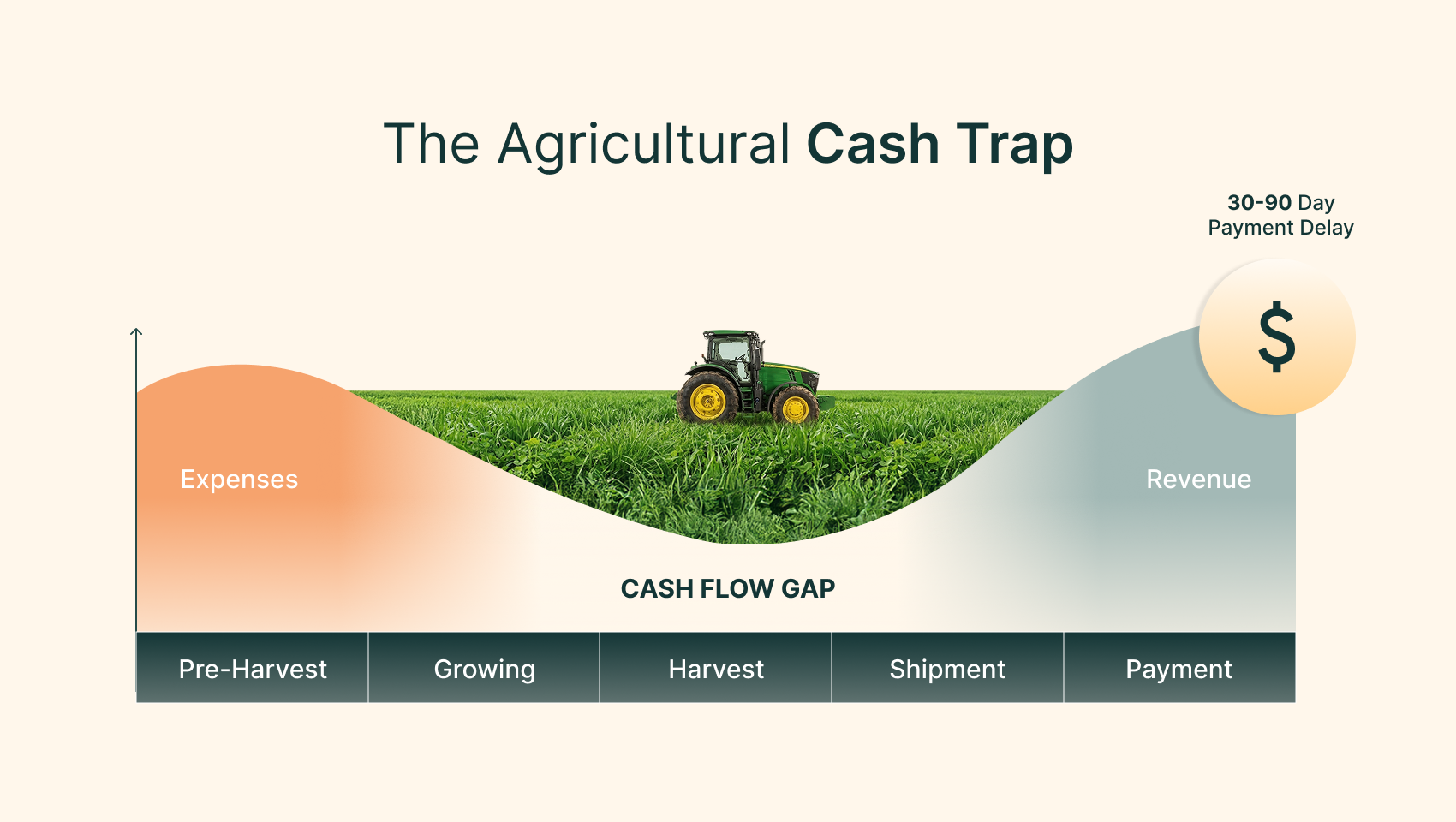
As shown above, the 30-to-90-day payment delay creates a valley where even the most successful growers can find themselves running out of runway.
Growers live in a world where their costs are immediate — labor, inputs, logistics, equipment — but their revenue is deferred. The gap between those two timelines isn’t a minor inconvenience. It’s a structural ceiling on how big a grower can actually get.
Here’s the pattern we see repeatedly across our network: A grower has a strong harvest season. Their buyer is satisfied. A bigger order is on the table. But to fill it, they need to invest now — in labor, packaging, transport, cold storage. And the only way to fund that investment is to wait for last season’s payment to clear.
So they take the smaller order. Or they decline altogether. Or they go to a traditional lender, spend weeks in underwriting, and come out the other side with a loan that may or may not arrive in time.
The opportunity passes. The grower stays at the same scale. The buyer finds another supplier who can handle the volume. And a farm that should have grown — didn’t.

Why this problem is invisible — until it isn’t
The harvest season cash trap is hard to see from the outside because it disguises itself as normal business. Payment terms of 60, 75, 90 days are standard in fresh produce. Everyone operates this way. So it doesn’t look like a broken system — it just looks like how the industry works.
But ‘how the industry works’ has a cost. That cost is measured in the farms that couldn’t expand, the relationships that fractured when a grower had to turn down a buyer’s order, and the years of growth that got pushed back because capital wasn’t available at the moment it was needed.
Traditional lenders don’t help much here. Agricultural lending — especially for produce growers — is notoriously slow and often poorly calibrated to the seasonal rhythms of the business. A grower who needs $200K in July to fund a fall order doesn’t need a 90-day underwriting process. They need a decision in days, based on the actual value of what they’ve already grown and sold.
This is what we built ProducePay to solve.
How we’re changing the runway calculation
ProducePay was built on a simple but powerful premise: if a grower has already produced the fruit, and a qualified buyer has already committed to purchasing it, the value is real. The risk is already priced. The payment is coming — it just hasn’t arrived yet.
Our platform bridges that gap. We use shipment data, buyer relationships, and market intelligence to unlock capital against invoices that are already in motion — turning a 90-day wait into same-week liquidity. Growers get access to the cash they’ve already earned, at the moment they need it most.
The impact isn’t just cash flow. It’s compounding. When a grower can say yes to a larger order in July, they build a stronger buyer relationship in August, which leads to better terms and more volume in the following season. That’s the difference between a business that’s treading water and one that’s actually growing.
What this unlocks in practice:
1. The ability to take larger orders without waiting for prior invoices to clear — because capital is available when the opportunity is.
2. Predictable cash flow across the seasonal cycle, so labor, inputs, and logistics can be planned rather than rationed.
3. Stronger buyer relationships because consistent supply and reliable fulfillment build the kind of trust that leads to preferred-supplier status.
4. Real growth — not on paper, but in volume, revenue, and the ability to finally take on that next region or that next buyer relationship that’s been on the table for two years.
A note for investors reading this
The harvest season cash trap isn’t just a grower problem. It’s a market inefficiency — and market inefficiencies at scale are investment opportunities.
The produce industry moves roughly $1.7 trillion in global value annually. The vast majority of that value is financed by the growers themselves, who carry the working capital burden while their buyers operate on extended payment terms. The financing infrastructure that exists to bridge this gap is fragmented, slow, and built on outdated credit models.
ProducePay sits at the intersection of the data, the relationships, and the capital markets access to change that. We see transaction data across thousands of shipments. We understand the risk profiles of buyers and growers across multiple geographies. And we’re building the financial layer that lets value move through the fresh produce supply chain the way it should — efficiently, transparently, and in real time.
The farms we work with aren’t distressed. They’re ambitious. And they’ve been held back not by a lack of demand, but by a lack of access to the capital they need to meet it.
Miguel’s fall order did get filled, by the way. Not because the 90-day payment terms changed — they didn’t. But because he had a partner who understood what his invoice was worth before the payment arrived.
That’s what unlocking runway actually looks like.
If you’re a grower navigating the seasonal cash gap, or an investor looking at the structural opportunity in produce finance — we’d like to talk.
